Bedpans, Bar Shifts, and Ballots: How Queer Workers Are Turning the Care Economy Into a Political Force

There's a joke that floats around queer circles: if every gay, trans, or nonbinary person walked out of the service industry on the same day, America would grind to a halt. The coffee wouldn't get made. The hotel rooms wouldn't get cleaned. The elderly wouldn't get bathed. The joke lands because it's uncomfortably close to the truth.
Queer people — particularly trans women, queer people of color, and gender-nonconforming workers — have historically clustered in caregiving, hospitality, and service jobs. Not always by choice. Discrimination in hiring, credential gatekeeping, and family rejection that cuts off access to financial safety nets have all funneled LGBTQ+ workers into industries that are essential, exhausting, and almost universally underpaid. But something is shifting. Across the country, those same workers are starting to build something that looks a lot like power.
The Economics of Being Pushed to the Margins
Let's be real about how we got here. LGBTQ+ workers face measurable wage penalties compared to their straight, cisgender counterparts — a gap that widens dramatically for trans workers and queer workers of color. A 2021 UCLA Williams Institute study found that LGBTQ+ adults are more likely to experience poverty and food insecurity than non-LGBTQ+ adults. When economic instability is your baseline, you take the jobs that are available, not the jobs you might have dreamed about.
Caregiving and service work — home health aides, restaurant servers, hotel housekeepers, childcare workers — are industries that have always depended on a workforce with limited options. They offer irregular hours, no benefits, poverty-level wages, and the kind of management culture that makes HR complaints feel like a punchline. For queer workers who've been pushed out of more credentialed professions or who lack family financial backing, these jobs aren't a stepping stone. For many, they're the whole staircase.
But here's the thing about being clustered together: it creates community. And community, as any organizer will tell you, is where power begins.
From Breaking Room to Bargaining Table
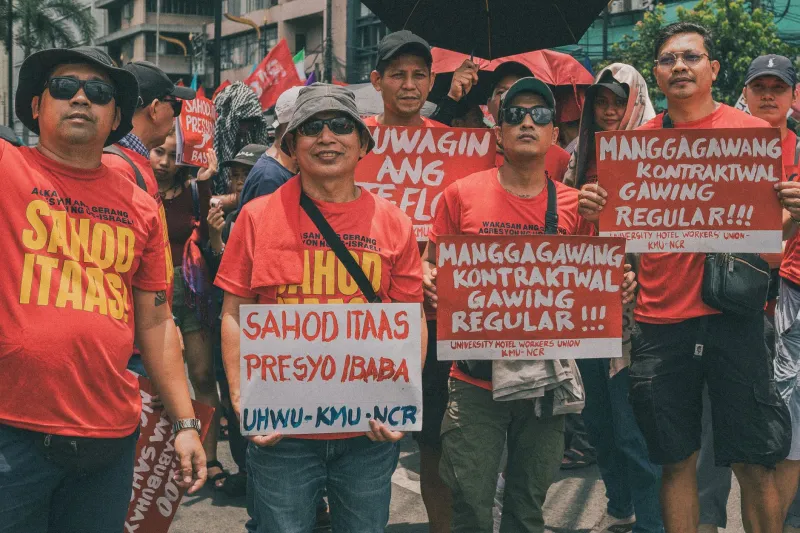
In cities like Chicago, Denver, and Atlanta, queer-heavy workforces in restaurants and hotels have been quietly driving some of the most energetic union drives of the past few years. Workers at several high-profile hospitality chains have cited LGBTQ+ worker networks as the connective tissue that made organizing possible — the group chats, the mutual aid circles, the informal solidarity structures that already existed before a union card ever got passed around.
"We already knew how to take care of each other," said one trans woman who helped organize a hotel housekeeping unit in the Southeast and asked not to be named for fear of retaliation. "That's literally what we do for a living. Turning that into a contract was just the next step."
In the home health and elder care sector, queer workers are navigating something even more complex. Many are employed by agencies that deliberately misclassify them as independent contractors to dodge benefits obligations. Others work in private homes where labor law protections are murky at best. For trans workers especially, the calculus of workplace organizing includes a very real fear: will coming out as a union supporter also mean being outed as trans to clients or employers who might respond badly?
Organizations like the National Domestic Workers Alliance and SEIU locals around the country have started explicitly centering LGBTQ+ workers in their outreach, recognizing that this population brings both motivation and organizing skill — and that they've been underserved by labor movements that historically defaulted to straight, cisgender worker archetypes.
Why the Money Trail Matters
Here's where campaign finance enters the picture, because it always does. The industries where queer workers are concentrated — restaurants, hotels, home care, childcare — are also industries whose trade associations spend millions every year lobbying against minimum wage increases, paid sick leave mandates, and union protections. The National Restaurant Association alone has spent decades earning its nickname "the other NRA" by kneecapping worker protections at both the state and federal level.
That lobbying money flows directly into the campaign accounts of legislators who then vote against the very policies — higher minimum wages, expanded Medicaid, federal anti-discrimination protections — that would most directly benefit LGBTQ+ care workers. It's a tight, cynical loop.
On the other side, labor unions and worker advocacy groups have increasingly directed political giving toward candidates who champion care economy reforms. And queer workers themselves, through political action committees tied to LGBTQ+ labor coalitions, are starting to show up as a funding constituency that campaigns actually have to account for. It's not yet at the scale of, say, the tech or finance sectors, but the trajectory is real.
The Visibility Advantage
One thing queer care workers have that other underpaid workers sometimes don't: a political identity that translates into advocacy infrastructure. LGBTQ+ organizations already have lobbying arms, donor networks, and media platforms. When queer workers in the care economy plug into that infrastructure, they gain access to political leverage that purely economic organizing might not generate on its own.
This is showing up in state-level fights over Medicaid expansion, which directly affects home care funding. It's showing up in campaigns for paid family leave, which trans workers have pushed to include gender-affirming care under its umbrella. It's showing up in city council races where queer hospitality workers are knocking doors not just for LGBTQ+ civil rights candidates, but for candidates who have signed onto living wage pledges.
The two threads — queer identity and labor economics — are becoming harder to separate, which is exactly the point.
What's at Stake
The care economy is only going to grow. America's population is aging. Demand for home health aides and elder care workers is projected to explode over the next two decades. Childcare remains a crisis with no federal fix in sight. Hospitality and food service employ tens of millions of people with no end to that demand either.
If those industries continue to be structured around poverty wages and disposable workers, queer people — already disproportionately represented in that workforce — will continue to bear the costs. But if queer workers can leverage their community networks, their political identity, and their growing presence in organized labor to reshape those industries, the wins wouldn't just be personal. They'd be structural.
That's the bet being made in break rooms and union halls from Miami to Minneapolis right now. The queer workers who've been told their labor doesn't deserve a living wage are deciding, collectively, that they disagree. And they're starting to have the receipts — and the organizing muscle — to prove it.